

Bots on Boards
Why Every Non-Profit (and Donor/Volunteer) Needs AI in Their Strategy

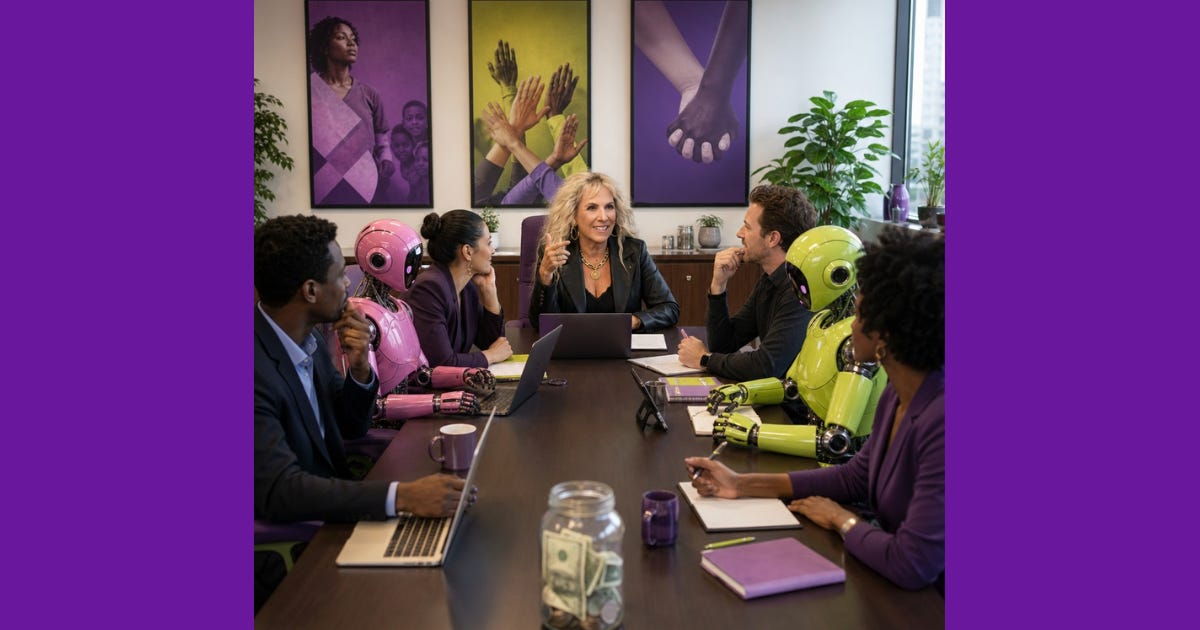
Love it or hate it…AI is here to stay.
That’s why every human needs to know more about it so they can apply its superpowers to good, rather than evil.
And one of those “goods” is charitable giving. As in flesh-and-blood people helping other humans.
My involvement in the world of charity has been choppy.
I did a fair amount of volunteer work as a kid/teen. Later in life, I never turned down a fun gala invite or failed to contribute to my daughters’ bake sales.
But I didn’t get really involved in the non-profit world until I fled corporate life and my kids were older. And then, giving back (however I could at that time) became part of my life routines.
Innovation and tech changed everything
Companies launched and scaled with embedded missions of giving back. The rubber chicken dinner and ho-hum silent auction were replaced (by some organizations) with memorable donor experiences. Sharing causes on social media and soliciting microdonations became commonplace.
And now, AI will give non-profits a whole new range of ways to raise money and help serve populations in need. And give people with big hearts more ways to give back. Here’s how…
For non-profits: 5 ways to put AI to work
1. Donor, marketing, and competitor analysis
Strip the names and emails out of your last three years of donor data. Drop the file into Claude, ChatGPT, or even all these agents. Try this:
Analyze this donor history. Identify the three patterns most predictive of a lapsed donor returning. Identify the three patterns most predictive of an upgrade. Recommend three campaigns to run in the next 90 days, with subject lines and target segments.
Similarly, let AI give you a direct critique of your last few years of fundraising events. Give it the data and let it run wild. Use it as a devil’s advocate.
Think like a for-profit entity and ask AI who your biggest competitors are for donations and how you can distinguish yourself from them.
For example:
What were the most successful non-profit fundraisers of 2025 in the category of [fill in your cause and/or geography]? Why?
2. Grant applications in 90 minutes, not three days
Feed the grant guidelines into AI. Paste in your mission statement, last year’s annual report, and three program outcomes. Try this:
Draft a 1,500-word grant application for [funder name] using the attached guidelines. Match their stated funding priorities. Include outcomes, beneficiary numbers, and a clear theory of change. Flag any sections where I need to add data you don’t have.
3. Impact reports donors will actually read
Turn this program data into a one-page impact story for donors. Include three concrete numbers, one composite beneficiary story (no real names), and one call to action. Eighth-grade reading level.
4. Tools worth a look
Salesforce Nonprofit Cloud + Einstein for donor scoring
Bloomerang AI for retention modeling
Givebutter for AI-assisted fundraising pages
Otter.ai for board meeting transcription
AI agents (like these) for basic tasks. New tools are being created daily, for everything from graphic design to event management. They can be a great way for non-profits to save time and money. Stay curious and open-minded.
Many AI tools have a free tier or trial period. Start there.
5. The rule
Only 43% of donors are okay with charities using AI. AI drafts. Humans edit.
Every donor-facing word must be reviewed by a human before it goes out. NO exceptions!
For donors: how to vet a charity in 5 minutes
Scammers now use AI to crank out professional-looking emails, websites, and video testimonials.
Before you give:
Check the watchdogs. Charity Navigator, CharityWatch, BBB Wise Giving Alliance. Not listed? Beware. But if you love an organization and have questions, reach out to the Executive Director on LinkedIn to learn more.
Search the IRS Tax-Exempt Organization tool. No 501(c)(3) listing means no tax deduction.
Run this prompt:
Research [charity name]. Pull their most recent Form 990. What percentage of revenue goes to programs versus admin and fundraising? Any lawsuits, investigations, or watchdog warnings? Compare them to two similar charities working on the same cause.
Reject pressure. Rushed, guilted, asked to wire money? Walk away.
Spot the lookalikes. Scammers use names that mimic the real ones.
For board members and volunteers: Big questions to ask this quarter
What is our written AI policy?
What donor or beneficiary data has been put into an AI tool, and was it anonymized first?
Which staff member has had formal AI training (not a one-hour webinar)?
Should we bring in a subject-matter expert (hint: me) to train our team and help us use AI and digital media responsibly?
The numbers (because AI is also really good at fast research, but be sure to triple-check all sources!)
92% of non-profits report using AI in some form
9% feel ready to use it responsibly
40% have zero staff trained in AI
10 to 24% have a written AI policy
68% of non-profit jobs globally are held by women, but we are adopting AI at a slower rate. Let’s catch up! Find training that works with your schedule and learning style. Reach out to me for tips.
Stay spicy, Nancy AF
Written and illustrated with my AI collaborator, Beulah. She researches, drafts, and edits. I direct, argue with her, and take full responsibility for the final words.
Sources:
AI Equity Project 2025 survey of 850+ nonprofits; BBB Wise Giving Alliance Give.org Donor Trust Report 2026; U.S. Bureau of Labor Statistics; AARP Fraud Watch Network; Charity Navigator; CharityWatch; IRS Tax-Exempt Organization Search; ThinkImpact Women in the Workforce 2026; Databoks global nonprofit employment data.